Hi. It’s been a minute since I last sat down to write. Life happened. I’m here again … so let’s get into it.
In a recent counselling session where we are trying to figure out finances, financial goals and essentially … how to get out of debt, and make smarter choices! Our counsellor James asked a question that completely stopped me in my tracks, I looked at Brody and he shrugged his shoulders as well…
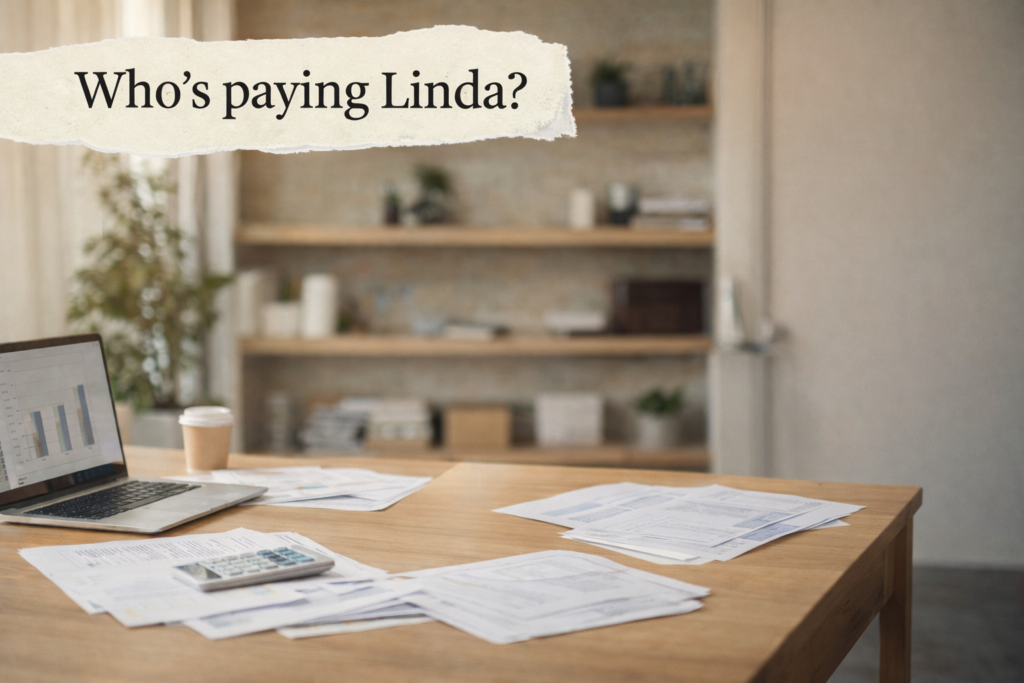
For context … Linda is our financial advisor. We started investing this year with her (better late than never right?!) Anyway, I laughed when I realized I had no idea who was paying her. Our counsellor said, “Well, someone is paying Linda!” I immediately thought: That’s a great name for a book about finances. Although, no one should ever take my advice about finances … yet … I’m a work in progress! However, that one question opened up a much bigger conversation about finances and mental health.
When you don’t know where your money is going, your nervous system fills in the blanks, and usually with anxiety. Even if things are technically fine, uncertainty keeps your body in a low-grade state of stress. As if I needed one more thing keeping me in my “my body thinks I’m running from a bear 24/7”.
For me, not knowing who was paying Linda wasn’t about the bill, it was about disconnection. Budgeting gets a bad rap. It sounds restrictive and shame-filled. But here’s the reframe that changed everything for me: Tracking isn’t about control – it’s about awareness. When you track your spending, you start noticing patterns, not failures.
Many of us overspend not because we’re bad with money, but because we’re looking for relief. And let me tell you … I can definitely see when my DoorDash/Uber eats monthly spend is more than a mortgage payment! And confession … I am exhausted and so I ordered food tonight … but like I said – work in progress … right?
Stressful day? Add to cart.
Anxiety spike? Online browse.
Burnt out? Treat yourself.
That purchase gives a quick dopamine hit, and most of the time, followed by guilt or shame.
Tracking helps you zoom out. Instead of asking “Why did I buy this?” you start asking:
- What was I feeling?
- What was I actually needing?
That’s where the mental health work comes into play.
Growing up, I always heard that talking about money was bad – taboo, impolite, something you keep to yourself. But…is it?
Maybe talking about money actually helps us make smarter choices. Maybe it helps us realize we aren’t as far behind as we think. Maybe it builds connection? AND maybe we’re all in the same damn ocean, just quietly panicking in our own corners of the sea … some of us yachts, some of us in a canoe with a hole in it and a bucket just bailing out as much water as we can so we don’t drown.
Predictability also calms the nervous system, and we all know majority of our nervous systems are jacked. Knowing what’s coming in and going out reduces panic and builds trust in yourself.
What I found is working for me was a Budget Spreadsheet. By “working” for me I mean in a sense that it helps me keep track of where my money is going. Instead of thinking, “I’m bad with money,” I am trying to reframe it to: “Oh — this is where my money goes when I’m stressed.” … and sometimes it ends in a “fffaaaccckkkk!” And then I want to shop because I’m sad and need a dopamine hit LOL!
(If you’re curious, this is the one I use:
stan.store/chelseaspursuit)
Sometimes, the most healing thing you can do is look at the numbers – gently and honestly.
Not to control yourself.
But to understand yourself.
Back, imperfectly in 2026!